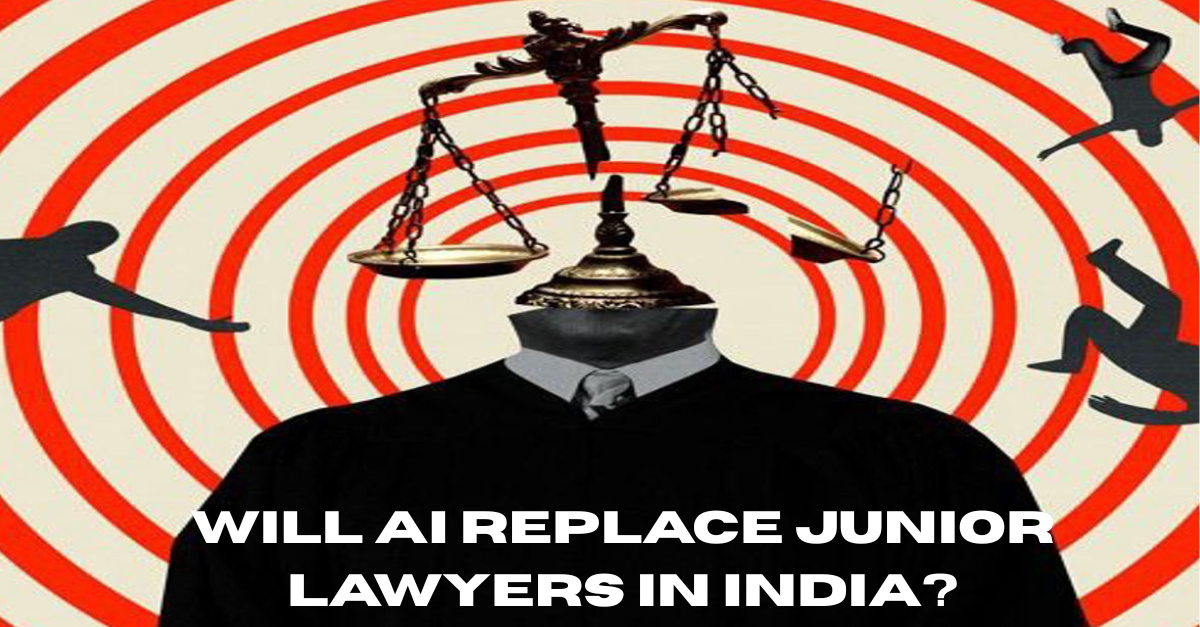
Introduction: The Myth
Picture this conversation at a managing partners' roundtable in Mumbai. One senior partner leans back and says what everyone's thinking: "We're paying lakhs per year for junior associates to do research and draft basic pleadings. AI can do that in minutes. Why are we still hiring juniors at all?"
The room nods. The logic seems airtight. If AI can summarize thousand-page discovery documents and draft faster than a first-year associate, what's left for juniors to do? The math is simple: one AI subscription costs what you'd pay two junior associates annually. Why not just cut headcount and scale AI instead?
This isn't paranoia. It's a real calculation happening across Indian law firms right now. Thomson Reuters reports that AI can save lawyers roughly 240 hours per year i.e. six full work weeks. [1] The myth feels less like a myth and more like an inevitable reality. So why wouldn't AI replace junior associates?
Why It Sounds True in Indian Law Firms
Let's be honest about why this myth has traction. First, the economics are undeniable. Indian law firms operate on tight margins as compared to the US or UK. When a single AI tool subscription costs less than hiring one junior associate for a year, the temptation to swap humans for software is real.
Second, the tasks AI handles best are precisely the tasks junior associates spend most of their time doing. Now, AI-powered tools can deliver relevant precedents, issue breakdowns and citations in seconds. Contract drafting? AI can generate first-pass NDAs, employment agreements and term sheets faster than any junior.
Third, Indian law firms have real precedent here. Look at what happened with typists and stenographers. Thirty years ago, every law office had multiple typing staff. Word processors eliminated that role entirely. Why wouldn't AI do the same to junior associates?
Where the Assumption Breaks Legally and Operationally
Here's where the myth collapses. AI doesn't replace junior associates because junior associates aren't paid to type. They're paid to maintain institutional memory, ensure consistency across matters, and escalate judgment calls to senior lawyers when needed. Let me explain with a real scenario that happens in every litigation practice.
Imagine your firm is handling a shareholder oppression dispute for a listed company. The case has been going on for eighteen months. Six months ago, a junior associate drafted a reply to the opposing counsel's notice under Section 241 of the Companies Act, taking a specific position on board meeting quorum requirements. Three months ago, that same junior reviewed minutes of board meetings and flagged potential contradictions. A well-trained junior associate remembers the position taken in that earlier reply. She recalls the board meeting minutes she reviewed. She flags the contradiction immediately.
Now ask AI to do the same task. You prompt it: "Draft an argument that the quorum requirement was waived by past practice." AI delivers a beautifully structured, legally sound argument. You file it. Two weeks later, opposing counsel's response lands on your desk, citing your firm's own contradictory position from six months ago. You're now arguing against yourself in the same matter. Who's liable? The partner who didn't catch it. Not the AI.
This is the operational reality partners miss. AI can draft brilliantly. But it has no memory of what your firm argued three months ago (at least most of them). Single-model AI forgets file history. It contradicts prior advice because it treats every prompt as a fresh query, detached from the matter's procedural history.
What Actually Happens in Practice
So what's really happening in Indian law firms that have adopted AI? They're not firing juniors. They're redeploying them. Here's the pattern across major firms: generative AI is now used daily by over 80 percent of lawyers at top Indian law firms, reshaping drafting, research, and document review workflows. But junior associate hiring at firms like Shardul Amarchand Mangaldas, Khaitan & Co, AZB & Partners, and Cyril Amarchand Mangaldas has remained relatively stable or selectively adjusted. [2]
Why? Because the firms using AI most aggressively discovered something critical: AI removes low-value repetition, not legal reasoning or accountability. Juniors are no longer spending five hours manually searching case law. AI does that in five minutes. But those freed-up hours aren't going away. They're being repurposed. Junior associates are now doing quality assurance on AI outputs, verifying citations, checking jurisdictional applicability and ensuring AI-generated drafts align with the firm's prior positions on the matter. They're becoming supervisors of AI work, not replacements for it.
What Firms Should Do Instead
So if AI doesn't replace juniors, what should partners actually do? The answer is deceptively simple: stop thinking about AI as a headcount replacement and start thinking about it as a workflow accelerator that needs human oversight. Here's the shift that forward-thinking Indian law firms are making.
First, redefine what juniors do. Stop assigning mechanical research and first-pass drafting to junior associates. Let AI handle that. Instead, train juniors to audit AI outputs. This is the new junior associate skillset: AI quality control, context maintenance and judgment escalation.
Second, implement AI with memory and audit trails. This is where most firms go wrong. They adopt generic AI tools like ChatGPT or general-purpose LLMs that treat every prompt as a standalone query. These tools have no memory of your firm's prior work. What you need instead is AI built with legal workflows in mind. Systems that maintain matter-level memory, that log every interaction, where multiple specialized agents handle discrete tasks. This is what separates legal AI systems from generic chatbots.
Third, measure the right metrics. Don't track "hours saved by AI." That's the wrong KPI. Track "quality improvement in junior associate work" and "reduction in rework caused by inconsistencies." If your juniors are catching more errors in AI outputs than AI is introducing, you've deployed it correctly. If AI is generating drafts that contradict your firm's prior positions, you've deployed it wrong.
Conclusion: This Is Where Custom, Compliance-Aware AI Matters
Here's what partners often miss until it's too late. Not all legal AI is built the same. Off-the-shelf chatbots can draft and research, but they can't maintain client matter context. This is where custom, compliance-aware AI becomes non-negotiable.
When AI is designed specifically for legal workflows, it doesn't replace juniors. It augments them. Juniors stop doing mechanical work and start supervising AI systems, verifying outputs and maintaining the institutional continuity that AI can't replicate. The myth that AI will replace junior associates collapses the moment you stop treating AI as a junior substitute and start treating it as a tool that requires junior oversight.
Sources:
[1] Thomas Reuters, How AI is transforming the legal profession, https://legal.thomsonreuters.com/blog/how-ai-is-transforming-the-legal-profession/
[2] Nucamp, Will AI Replace Legal Jobs in India? Here’s What to Do in 2025, https://www.nucamp.co/blog/coding-bootcamp-india-ind-legal-will-ai-replace-legal-jobs-in-india-heres-what-to-do-in-2025.