Introduction
A dispute lawyer is not one brain doing one task. She is a coordinator of multiple roles from soliciting clients to representing them in courts. Now what if I tell you that an agentic system can mirror these exact tasks, not to replace that lawyer but to only augment her. This blog breaks down exactly how AI can augment a dispute lawyer.
How Dispute Lawyers Actually Work: The Multi-Role Reality
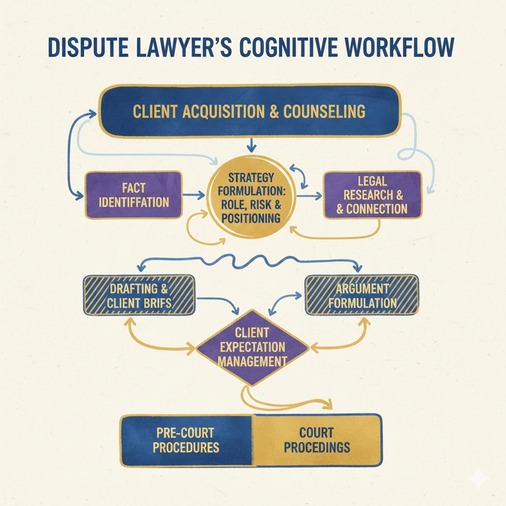
A typical dispute lawyers’ workflow includes client acquisition and counselling, research, drafting, client briefs, argument formulation etc. before finally appearing in court proceedings. And to perform these tasks, there are multiple cognitive roles at work that run in parallel. A lawyer needs to identify the facts, then connect it to law. Strategize her role, tasks and position to avoid risk while following the legal procedure. And of course, deal with the client's expectations.
What Are Multi-Agent AI Systems?
With the advent of AI, multi-agent systems can augment lawyers to perform these day-to-day tasks more efficiently. You must be wondering what are these multi-agent systems, right? As per Google Cloud, “A multi-agent system comprises multiple autonomous, interacting computational entities, known as agents, situated within a shared environment." [1] Sounds daunting, right? Picture this: just like any law firm workspace where there are associates led by senior associates, who are responsible to partners. Multi-agent systems are different agents working on different specialized tasks just like any associate, reporting to another supervising agent. These agents act as task-specific reasoning units with specialized roles and clear responsibilities. There’s controlled interaction between each of them which helps in escalation of human judgment.
Inside a Multi-Agent Dispute Workflow
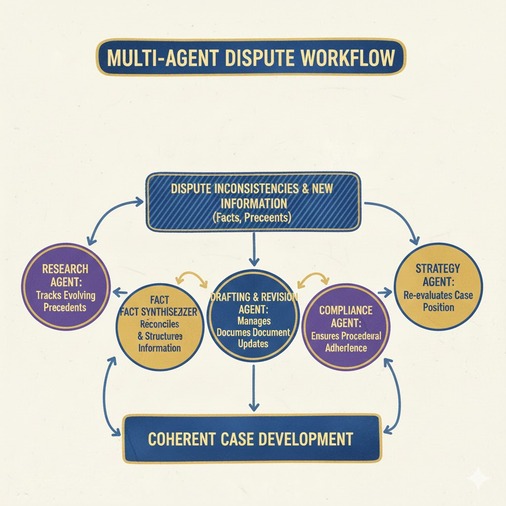
A dispute lawyer deals with a lot of inconsistencies on a day-to-day basis. Disputes are messy, information arrives at different times with facts of the matter changing frequently. Sometimes, precedents evolve mid-matter and drafts are often revised repeatedly. So, to put it in this way, dispute work can fracture our attention. However, these multi-model agentic systems exist to contain these fractures. Each agent responds to specific failures; when precedents shift mid-argument, the Research Agent comes to rescue. This agent is responsible for tracking evolving precedents in a dispute lawyers' workflow. Similarly, when facts of any matter are scattered across pleadings, annexures or statements, a Fact Synthesis Agent gets to work. To ensure coherent flow of facts, a Fact Synthesis Agent would align pleadings, evidence and timelines. Parallelly, a Drafting Agent would first pass the structure, while a Strategy Agent works to flag inconsistencies or any counter-positions. And finally, a Compliance or a Citation Agent would ensure jurisdictional accuracy when citations quietly become a liability.
Why Single-Model AI Fails for Dispute Resolution
Since now you’ve understood what multi-model agents are, let’s pan our focus on single-model AI and why it fails in dispute resolution. Single model AI are one- size-fit-all AI agents taking up diverse tasks and giving sub-standard responses, quite literally. [2] A single model answering a dispute query is like a junior giving advice without knowing the file history. Since, disputes are non-linear and the inputs are fragmented with reasoning unfolding across time, The one-shot responses of single model AI create an ever compounding error. To cope up with all the intricacies of a dispute matter, a multi-agent AI system suits best as it actively curbs hallucination and consists of individual specialized agents with subject-matter expertise.
Advent of Intentional Multi-Agent Law Firms
Dispute lawyers don’t fall short on expertise. They fall short where systems don’t exist or are inadequate. The gaps usually lie in coordination, continuity, and workflows that were never designed for this level of complexity. In reality, most law firms already operate as multi-agent systems, just accidental ones, held together by people rather than design. As dispute work grows more complex, the question worth asking is simple: where does your practice rely on human judgment, and where does it rely on memory, coordination and systems that could be intentionally built to work better.
Sources:
[1] Google Cloud, Multi-agent systems, https://cloud.google.com/discover/what-is-a-multi-agent-system.
[2] IBM, What is agentic architecture?, https://www.ibm.com/think/topics/agentic-architecture.
[3] Medium, Multi-Agent AI Systems: Foundational Concepts and Architectures, https://medium.com/@sahin.samia/multi-agent-ai-systems-foundational-concepts-and-architectures-ece9f8859302
[4] Gloat, AI-Augmented Workforce: Shaping the Future of Work, https://gloat.com/blog/ai-augmented-workforce/
[5] NASSCOM, Multi-Model AI Agents vs. Single-Model Systems: What Businesses Must Know, https://community.nasscom.in/communities/ai/multi-model-ai-agents-vs-single-model-systems-what-businesses-must-know.