Research a point of law, cited to the real order or judgment.
Ask me in plain words and I come back with the position and the authorities to cite, each linked to its source, so you can verify before you rely on it in court. On WhatsApp or App.
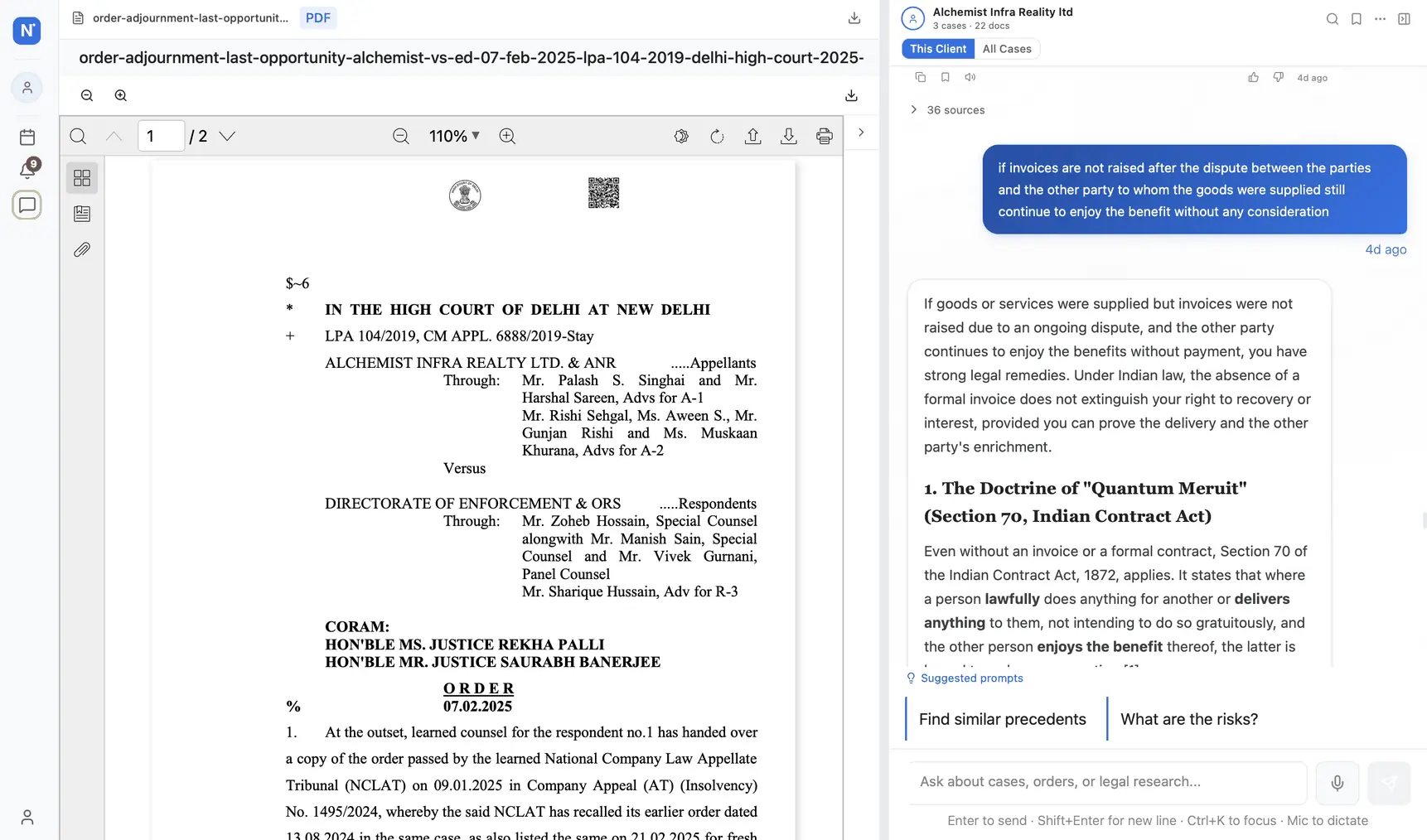
A grounded answer with inline citations. Click any citation to land on the source.
What it does
Answers grounded in real orders and judgments
Every position I give you is drawn from an actual order or judgment, never invented.
Every citation links to its source
Click any citation and land on the paragraph it came from, so you can verify before you rely on it.
Case-aware
Ask about your own matter and I answer from your files and the orders on record.
Common questions
Nowlez uses Google Gemini (currently Gemini 2.0 Flash for most queries, with escalation to Gemini 2.5 Pro for drafting and multi-document analysis). The choice is based on Gemini's strong performance on long-context legal material: individual court orders in India can run to 50+ pages, and Gemini handles the context window that would truncate on other models.
Citations are grounded, not generated. I retrieve from an indexed corpus of your uploaded documents and a curated statute plus case-law dataset, then cite only items actually retrieved. Every citation links back to the source: click it and you land on the paragraph the answer came from. If the retrieval comes up empty, I say so instead of inventing one.
No. I do not use your uploaded documents or chat transcripts for model training. Google's Gemini API is invoked in a per-query mode with no training-data retention; the retrieval indexes are scoped per-account and not shared between users.
Yes. The statute corpus covers the Bharatiya Nyaya Sanhita (2023), Bharatiya Nagarik Suraksha Sanhita (2023) and Bharatiya Sakshya Adhiniyam (2023), alongside the legacy Indian Penal Code, Code of Criminal Procedure and Indian Evidence Act for pending-case work. I flag which regime applies based on the filing date you have recorded.
Yes, for retrieval and summary. Documents in Devanagari, Tamil, Marathi, Bengali and Gujarati are indexed and searchable; I can summarise them back to you in the source language or English. Drafting in vernacular languages is on the roadmap.
For many common workflows, yes. For deep precedent research, or when you need the exact headnotes and editorial commentary of a paid database, no. The honest positioning: I complement a paid database for most practices, and replace it entirely for solos who do not have a subscription. The comparison page has the full matrix.
Included with Chambers.
Start free trial