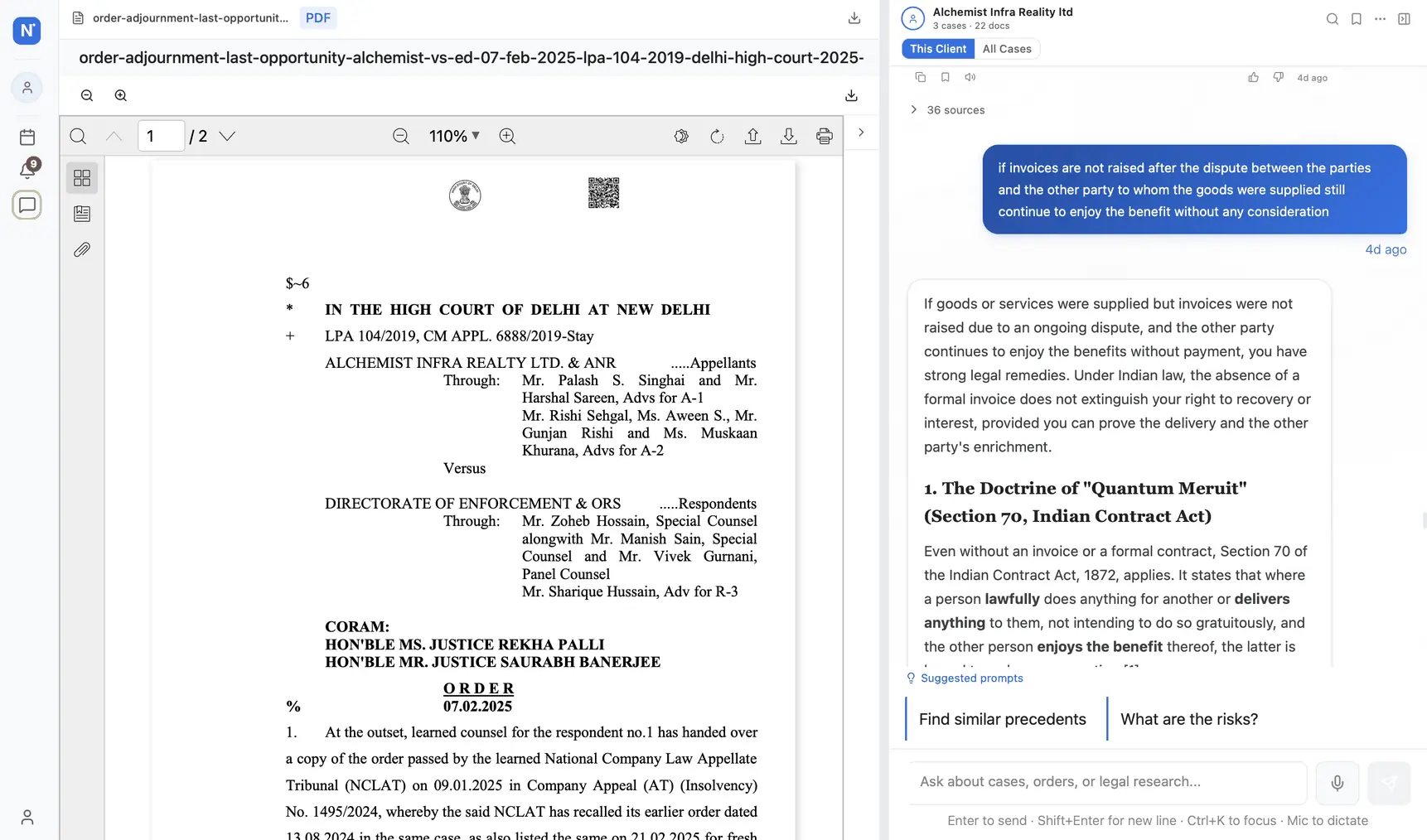
Ask questions about a matter. Get an answer in plain English with citations to the specific paragraph in an order, the relevant provision of the BNS, or the case document you uploaded last week. Every claim is traceable; nothing is hallucinated.
The honest problem with most "AI for lawyers" tools is trust. When a chatbot cites a Supreme Court judgment that doesn't exist, or a section number that's been repealed, the cost of the mistake falls on you — and you don't find out until opposing counsel does. Nowlez's AI is built to be wrong in a way you can catch, not in a way that surprises you in court. Every citation points at a retrievable source, and we deliberately say "I don't know" more often than "here's a plausible-sounding answer."
Underneath, the AI has three contexts stacked on top of each other: your own case files (everything you've uploaded, plus what we pull from court records for real-time case tracking), a curated statute corpus covering both the new BNS / BNSS / BSA regime and the legacy IPC / CrPC / Evidence Act, and a growing index of reported judgments from the Supreme Court and participating High Courts. Every question is answered using the retrieval that fits — a question about your pending bail application draws from your files; a question about Section 482 of the CrPC draws from the statute text; a question about a recent precedent draws from case-law retrieval.
A grounded answer with inline citations — click any citation to land on the source paragraph.
What it does
Case-Aware Chat
Ask a question in plain language; the AI grounds its answer in your uploaded documents, court orders, and case history. Every claim is cited to a retrievable source.
Statute + Case-Law Research
Retrieves from the BNS / BNSS / BSA 2023 text alongside the legacy IPC / CrPC / Evidence Act. Case-law retrieval covers reported SC and HC judgments.
Drafting Assistance
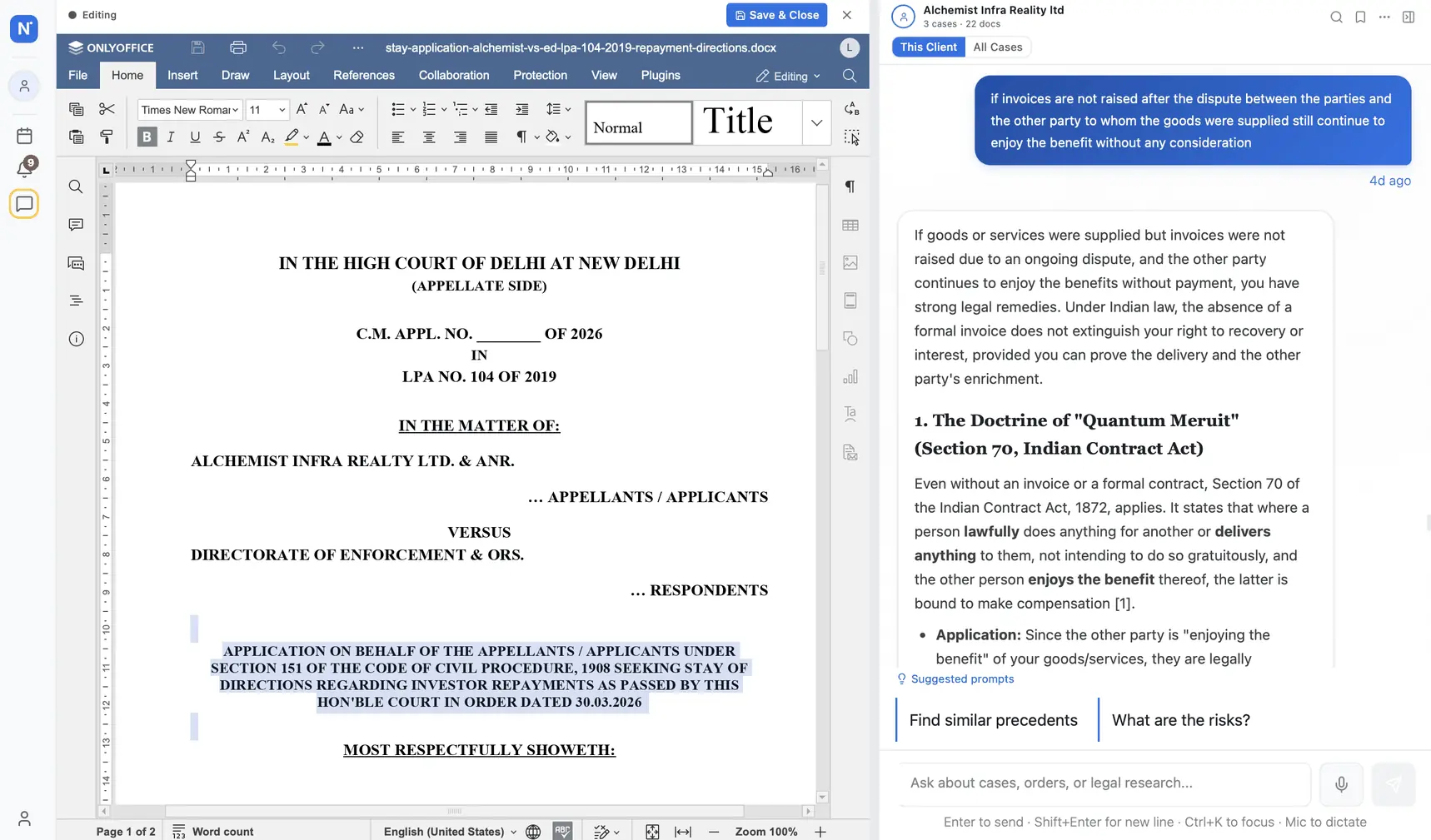
Generate first drafts of petitions, bail applications, replies, and notices from your case facts, not from generic templates. Always delivered editable.
How advocates use it
Bail-matter specialist
Uploads the chargesheet and asks: "Which grounds from Arnesh Kumar v. State of Bihar apply here?" The AI pulls the relevant ratio, maps it to the facts from the chargesheet, and cites both.
→ Research for a bail application in 10 minutes instead of 2 hours
Commercial litigation associate
Asked for a first-draft reply to a plaint under Order VIII of the CPC, citing the admissions in the plaint and the limitation points. Gets a usable draft they can edit in 20 minutes.
→ Drafting hours cut in half
In-house counsel, FMCG
Uploads a consumer-forum complaint, asks "Are we in limitation?" and "What's the right defence strategy?" — AI cross-references the Consumer Protection Act 2019 and the uploaded invoice timeline.
→ 15-minute triage instead of a junior's full-day review
How a research question actually flows
Traditional workflow
1
Walk over to the library shelf
Bare Act, relevant commentary, AIR volumes. 10 minutes.
2
Search headnotes manually
Leafing through reporter indices looking for the principle you half-remember.
3
Cross-check on a paid database
ManuPatra / SCC Online session. Good retrieval but expensive and slow to navigate.
4
Copy-paste into your draft
Hand-type citations, risk typos in case numbers and section references.
With Nowlez
1
Ask in plain English
"Is there any Supreme Court case on maintainability of a writ when an alternative remedy is available?"
2
Get a grounded answer
Key principles summarized; each citation clickable to the source.
3
Narrow with follow-ups
"Apply that to my facts — the client has already filed a revision." AI uses your case files.
4
Copy with citation-ready formatting
Output includes properly-formatted citations. Paste into the pleading, verify, submit.
Drafting a reply to a plaint — facts pulled from the uploaded chargesheet, citations inline.
Common questions
Nowlez uses Google Gemini (currently Gemini 2.0 Flash for most queries, with escalation to Gemini 2.5 Pro for drafting and multi-document analysis). The choice is based on Gemini's strong performance on long-context legal material — individual court orders in India can run to 50+ pages, and Gemini handles the context window size that would truncate on other models.
Citations are grounded, not generated. The AI retrieves from an indexed corpus of your uploaded documents and a curated statute + case-law dataset, then cites only items actually retrieved. Every citation links back to the source — click it and you land on the paragraph the answer came from. If the retrieval comes up empty, the AI says so instead of inventing one.
No. We explicitly do not use your uploaded documents or chat transcripts for model training. Google's Gemini API is invoked in a per-query mode with no training-data retention; our own retrieval indexes are scoped per-account and not shared between users. Documents are encrypted at rest.
Yes. The statute corpus covers the Bharatiya Nyaya Sanhita (2023), Bharatiya Nagarik Suraksha Sanhita (2023), and Bharatiya Sakshya Adhiniyam (2023), alongside the legacy Indian Penal Code, Code of Criminal Procedure, and Indian Evidence Act for pending-case work. The AI flags which regime applies to a case based on the filing date you've recorded.
Yes. Scope the request tightly — "draft paragraph 4, the cause of action" — and the AI generates a first pass using your uploaded facts. Output is always editable; we don't auto-submit anything. The drafting assistant is designed for solo lawyers who need a starting point, not for senior counsel who already have their own voice.
Chambers includes 500 chats per month. A "chat" is a single back-and-forth exchange; a follow-up question on the same topic is a new chat. You can see your remaining quota at the top of the chat panel.
Yes, for retrieval and summary. Uploaded documents in Devanagari, Tamil, Marathi, Bengali, and Gujarati are indexed and searchable; the AI can summarize them back to you in either the source language or English. Drafting in vernacular languages is on the roadmap.
For many common workflows, yes. For deep precedent research or when you need the exact headnotes and editorial commentary of a paid database, no. The honest positioning: Nowlez's AI assistant complements a paid database for most practices, and replaces it entirely for solos who don't have a subscription. Our comparison page has the full matrix.